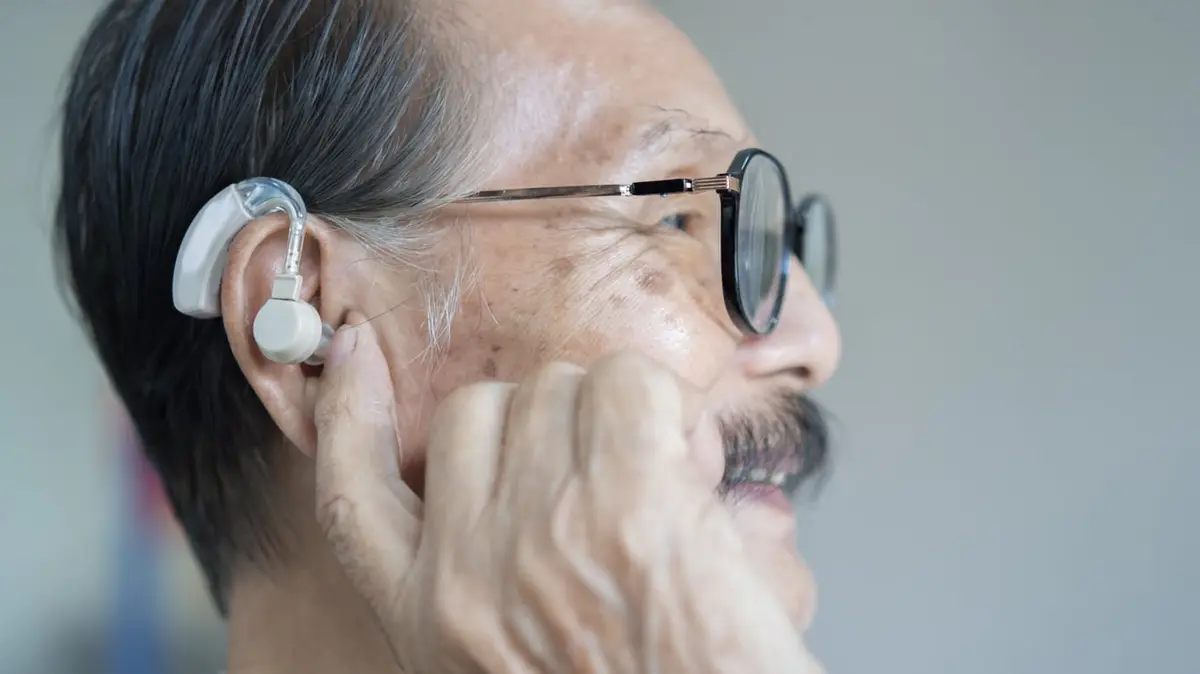


A hearing aid can sound wonderful in a quiet room and still fail you on the phone. Calls are a different test. The caller has to reach both ears clearly, your own voice has to reach the caller, and the whole thing has to work while you are walking, cooking, or sitting in a noisy cafe. That is why “good for phone calls” is a separate question from “good sound quality”, and why two aids with the same Bluetooth logo can behave very differently when the phone rings.
This guide explains what actually makes a hearing aid good for calls, then names the models that do it best right now, grouped by budget and by where you buy them. It follows on from our pairing guides: if you have not paired your aids yet, start with how to connect hearing aids to Android or how to pair hearing aids with your iPhone, then come back here to judge whether your aids handle calls the way you need.
What “Good for Phone Calls” Actually Means
Four things decide whether calls work well. First, both ears should get the call, not just one, so the voice sounds centred and clear instead of thin and one sided. Second, your own voice has to be picked up somewhere sensible. Third, the aids should stay connected to more than one device, so a call on your phone does not get lost because the aids are still holding on to your laptop. Fourth, call clarity has to survive background noise, because most real calls do not happen in silence.
Hands-Free Calling vs Streaming-Only Calling
True hands-free calling means the caller streams to both aids and the hearing aid microphones pick up your voice. Your phone can stay in your pocket or your bag. Phonak models with Classic Bluetooth do this on both iPhone and Android, and newer LE Audio models do it on compatible phones. You answer with a tap on the aid or a press of its button, talk normally, and hang up the same way.
Streaming-only calling means the caller streams to your aids, but your voice is picked up by the phone microphone. The phone has to stay near your mouth, which is fine at a desk and awkward everywhere else. Many older aids that only support MFi on iPhone or ASHA on Android work this way. They still advertise Bluetooth, and the streaming part is real, but the call is not hands-free.
| Call type | Caller hears you through | Where the phone must be |
|---|---|---|
| True hands-free | The hearing aid microphones | Anywhere nearby, pocket or bag is fine |
| Streaming-only | The phone microphone | Near your mouth |
When you shop, ask one direct question: does my voice go back through the aids, or through the phone? If the answer is the phone, you are looking at streaming-only calling, and it should be priced and judged as a different product.
How Hands-Free Calling Works
iPhones use MFi, Android phones use ASHA on Android 10 and later, and newer phones and aids use LE Audio with the Hearing Access Profile, which needs Bluetooth 5.2 or higher on both sides. Phonak takes a fourth route, Classic Bluetooth, which is why its aids can do hands-free calls on both iPhone and Android. The point is simple: the phone and the aids must share a protocol that carries your voice as well as the caller’s.
Best Overall for Hands-Free Calls: Phonak Audeo Infinio and Sphere Infinio
Phonak is still the safest answer if hands-free calling is your top priority. The Audeo Infinio and Sphere Infinio lines use universal Bluetooth, so hands-free calls work on iPhone and Android alike. They pair with up to eight devices and keep two active at once, and tap control answers and ends calls.
The newer EON Sphere models add up to 38 hours per charge, and recent pricing guides put them at roughly $2,998 to $4,098 per pair through a clinic. The older Lumity line works the same way for calls, so a Lumity at a lower price is usually worth taking. One warning from audiologist Cliff Olson’s Lumity review: Phonak cannot turn off aid-microphone voice pickup during a streamed call, and soft voices can be hard for the aid microphones to pick up. Test a real call in the clinic before you commit, with the phone in your pocket.
Best OTC Pick: Jabra Enhance Select
Jabra Enhance Select is the strongest over-the-counter option for callers. The current M3 model is listed at $1,995 per pair, with Bluetooth LE Audio, Auracast readiness, and hands-free calling on iPhone and Android. A double tap on the aid answers a call. The newer Select 700 is listed at the same $1,995 per pair, so check which model a seller is quoting before you compare prices.
Jabra is sold online with remote support from licensed hearing care professionals, so the price includes remote programming rather than in-person visits. That suits people happy to adjust settings in an app. Our Lexie B2 Plus vs Jabra Enhance comparison covers the buying experience in more detail.
Best LE Audio Picks: ReSound Nexia and Starkey Edge AI
If your phone supports LE Audio, ReSound and Starkey are the two prescription brands to check alongside Phonak. The ReSound Nexia, and its newer Sensia line, were among the first aids to support LE Audio with Auracast, with hands-free calling and two devices connected at once. Starkey Edge AI and the newer Omega AI are Auracast-ready with hands-free calling and two simultaneous connections as well.
Best at Costco: Sennheiser Sonite Rise and Philips HearLink
Costco remains the best value route for prescription-style aids. The Sennheiser Sonite Rise, built on Phonak’s Infinio R platform, is listed at $1,599.99 per pair, with true hands-free calling on both iPhone and Android, a three-year warranty, and 180-day returns. It has no telecoil and no LE Audio or Auracast, so it is a call-first choice rather than a future-proof one.
The Philips HearLink 9050 is the same $1,599.99 per pair, with Auracast and a telecoil, so it is the better pick if you want LE Audio now and a hearing loop option later. The Rexton Reach R Plus is also $1,599.99, with up to 54 hours per charge and hands-free calling on both platforms. Test all three in the warehouse: the staff can put the aids on you and ring your phone while you stand in the store.
Best Budget OTC: ELEHEAR Beyond Pro and Audien Ion Pro 2
Budget over-the-counter aids have improved faster than any other part of this market. The ELEHEAR Beyond Pro is listed at $649 per pair in recent 2026 roundups, with Bluetooth 5.3 and hands-free calling on both iOS and Android, plus about 20 hours of rechargeable use. The Audien Ion Pro 2 is the cheaper pick in the same group, with Bluetooth streaming and hands-free calling at a budget price.
These models are for mild to moderate hearing loss and are fitted by you, with no in-person call test before you buy. Use the trial period: make real calls in real places in the first week, and send them back if the other person keeps asking you to repeat yourself.
Call Features Worth Checking Before You Buy
Before you pay, check four things. How do you answer a call: tap, double tap, button press, or only from the phone screen? Can you trigger your voice assistant from the aids? Can you balance streaming volume against the sound around you? And what does heavy streaming do to battery life? Four hours of streaming a day can cut a rechargeable aid from a full day to about 16 hours. Finally, ask about live captioning: Phonak’s myCall-to-Text app captions calls in more than 80 languages.
When Calls Sound Bad: Quick Fixes
Most bad calls are settings problems, not broken aids. If the call goes to the phone speaker instead of your aids, check the Bluetooth icon on the call screen and make sure the aids are selected as the audio route. If only one aid carries the call, pair each aid separately. If your own voice sounds too loud or too quiet to the caller, ask your fitter to adjust the own-voice pickup level.
If none of that helps, the problem may be the protocol limit described earlier: an aid that only streams cannot be made hands-free by a setting change. The options then are a streamer accessory from the maker, or a different aid. Our deeper guide on a hearing aid not connecting to phone covers the full range of connection fixes, and our guide on hearing aid sounds muffled covers the physical causes when the sound itself is the problem.
Landlines and Aids That Do Not Stream
Not every call comes from a smartphone. For a landline, the useful options are a streamer accessory, a telecoil with a hearing loop, or a captioned telephone service, which shows the caller’s words as text and is free in many places. If you buy mainly for landline calls, tell the fitter first: a telecoil adds size and cost, and many slim rechargeable models leave it out, including the Sennheiser Sonite Rise above.
The bottom line: buy the call, not the Bluetooth logo. True hands-free calling is worth paying for if you take calls on the move. Phonak Infinio and Sphere Infinio do it best across both phone platforms, Jabra Enhance Select is the strongest over-the-counter route at $1,995 per pair, and Costco’s $1,599.99 lineup is the best value for a prescription-style aid. Whatever you choose, test it on real calls during the trial period, with the phone in your pocket, before the return window closes.
Frequently Asked Questions
Which hearing aids are best for phone calls?
Phonak Audeo Infinio and Sphere Infinio are the best overall for hands-free calls on both iPhone and Android. Jabra Enhance Select is the best over-the-counter pick, and the Sennheiser Sonite Rise at Costco is the best value prescription-style pick.
Can I take hands-free calls with hearing aids?
Yes, if your aids and phone share a protocol that carries your voice as well as the caller’s. Phonak’s Classic Bluetooth and newer LE Audio models do this. Older MFi-only or ASHA-only aids may stream the caller to your ears but pick up your voice through the phone instead.
Do I need LE Audio for good phone calls?
No. LE Audio helps, and it uses less battery, but Classic Bluetooth hands-free calling on Phonak aids works well today. LE Audio only helps if both your phone, with Bluetooth 5.2 or higher, and your aids support it.
Why can the caller hear me badly even though I hear them fine?
Your voice is probably being picked up by the aid microphones, which struggle with a soft voice or background noise, or the call is using the phone microphone from a distance. Ask your fitter to adjust own-voice pickup, and test calls with the phone in your pocket.
Are budget OTC hearing aids good for phone calls?
Some are. The ELEHEAR Beyond Pro and Audien Ion Pro 2 offer hands-free calling on both platforms at budget prices. They suit mild to moderate hearing loss, but test them on real calls in the first week and use the return window if the caller cannot hear you clearly.
External sources: Stanford Hearing, best Bluetooth hearing aids, Wareable, best Bluetooth hearing aids 2026, NCOA, best hearing aids 2026, Hearing Buddy, Costco hearing aids 2026, Altrincham Hearing Centre, hands-free calls with hearing aids, Phonak Audeo Paradise, tap control and hands-free calls, Direct Hearing, Phonak Bluetooth capabilities by model.